
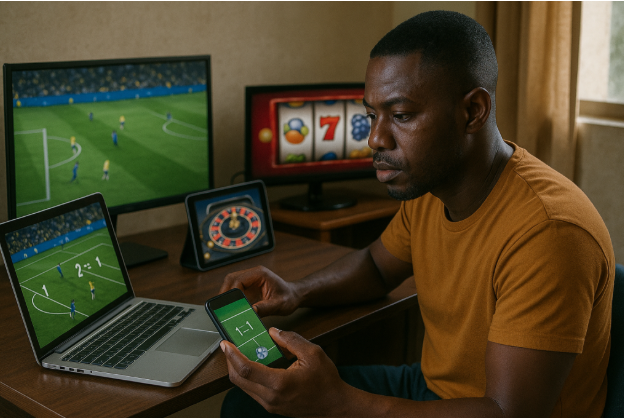
Across Africa, betting has evolved into a digital economy connecting sport, entertainment, and finance. Long ago, betting relied on paper slips and radio commentary. Today, mobile phones and payment systems have turned the same habit into an organised industry. The modern player balances between two worlds – sports wagers based on skill and casino games powered by chance.
Digital platforms changed both. They created a shared space where people track matches, spin virtual reels, and follow statistics in real time. Many users discover new features through seasonal promotions and loyalty systems. Some access rewards through an exclusive promo code 1xbet tanzania, which reflects how bonuses became a part of regular gameplay. Behind this convenience lies a growing economic structure that defines African entertainment in the twenty-first century.
Sports and casino betting may seem similar, yet their logic, risk, and rhythm differ entirely.
Roots of two betting cultures
Sports betting grew naturally across countries where football and athletics dominate public life. Fans already discussed scores and players daily; betting simply added numbers to passion. Casino gaming, in contrast, came later through mobile technology. Its spread did not depend on stadiums or television but on smartphone access.
The two forms share one financial framework but serve different mindsets. Sports bettors rely on study and prediction, while casino players look for probability management and pacing.
Sports betting habits across Africa
African sports betting follows the pulse of local football and international tournaments. Weekly fixtures from major leagues shape how players plan their wagers. Bookmakers build odds using both global data and local enthusiasm. In football-heavy regions, prediction games became part of weekend culture.
Typical sports betting patterns include:
- Small daily wagers on local league matches
- Accumulator bets across several competitions
- Preference for football, followed by basketball and rugby
This format links entertainment with participation. It rewards observation and memory, not only luck.
Casino betting and digital entertainment
Casino platforms adapt faster to technology than traditional bookmakers. They rely on variety – slots, roulette, crash games, and live dealer tables. The experience feels more private but visually intense. Unlike sports betting, results depend on mathematical models instead of external events.
Modern casino design blends probability with presentation. Themes, music, and animation form an experience closer to digital art than gambling. Games must balance return rates and excitement through continuous testing and refinement.
In recent years, developers began applying artificial intelligence to improve these experiences. AI changing sports betting also influences casino design by predicting user fatigue and adjusting visual flow. Such integration connects analytics with storytelling, making each game session feel personal.
Economic structure behind both markets
Both sports and casino betting generate stable income for platforms through small margins repeated at scale. Each wager contributes to a collective pool that sustains operations and bonuses. However, their expenditure models differ.
Sports platforms invest more in live data, odds monitoring, and event partnerships. Casino operators focus on software licensing, server reliability, and payment gateways. Despite differences, both depend heavily on trust and transparent transaction flow.
Main costs usually include:
- Licensing and digital compliance
- Data feed subscriptions and software updates
- Payment system integration
- Marketing and local partnerships
As more African governments adopt digital tax frameworks, both forms of betting evolve into legitimate sectors contributing to public revenue.
Behavioural contrast and timing
Sports betting mirrors patience. Players wait through matches, study statistics, and follow news. Casino betting offers immediacy – results appear in seconds. This difference creates distinct user cycles. Sports bettors log in during weekends; casino players engage daily in shorter bursts.
Yet, crossover between both worlds grows steadily. Many platforms combine sports and casino products within one interface. Data suggests users alternate between the two depending on mood and available time.
Cultural perception and social impact
In African cities, sports betting often blends with community interaction. Friends gather around screens, discuss odds, and compare predictions. Casino gaming remains more individual, favoured during quiet hours or mobile sessions. Both, however, reflect a shared pursuit of controlled risk within structured systems.
Mobile integration made betting part of everyday entertainment. Digital wallets, simplified registration, and reduced transaction costs opened access to millions. Local operators now develop region-specific content, using familiar languages and symbols to maintain authenticity.
A shared digital future
Sports and casino betting may follow different mechanics, but both express Africa’s appetite for digital entertainment. As internet access expands, the two industries will likely merge further. Betting becomes less about separation and more about interaction – one continuous cycle of data, design, and decision-making.
The same trend that once divided skill and chance now links them through innovation. Over time, Africa’s betting market will stand not as imitation but as a distinct model – rooted in local culture, supported by technology, and shaped by both play and analysis.


Leave a Reply